The United Nations continues to emphasize the importance of empowering youth and ensuring their meaningful participation in addressing global challenges. Youth empowerment involves engaging new generations in problem-solving and decision-making processes, including promoting adherence to the international legal framework to counter chemical, biological, radiological and nuclear (CBRN) terrorism.
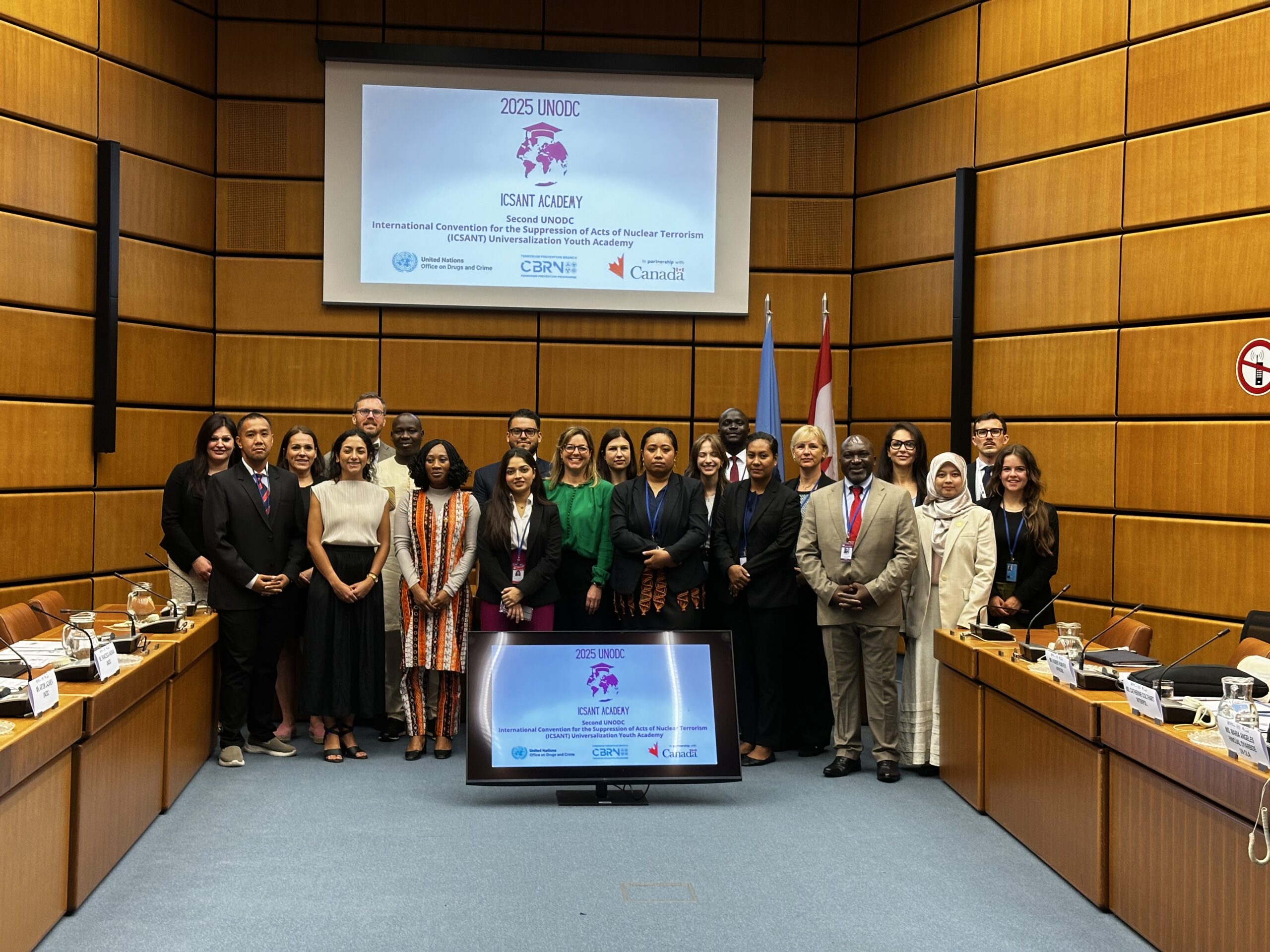
Guided by this vision, the CBRN Terrorism Prevention Programme of the United Nations Office on Drugs and Crime (UNODC) Terrorism Prevention Branch (TPB), hosted the Second UNODC International Convention for the Suppression of Acts of Nuclear Terrorism (ICSANT) Universalization Youth Academy. The event took place from 7 to 10 July 2025 in Vienna, Austria.
The initiative, made possible with the support of the Government of Canada, aims to foster emerging leaders up to 35 years of age holding a governmental role relevant to adherence to ICSANT and equip them with the knowledge and skills necessary to advocate for their State to become party to the Convention. The event builds upon the success of the first ICSANT Academy held in Vienna in September 2024.
In her opening remarks, Ms. Angela Veitch, Counsellor and Deputy Permanent Representative of Canada to the International Organizations in Vienna, stressed the importance of the Convention and thanked participants for their dedication in becoming ICSANT champions:
“The Academy is an initiative UNODC and Canada are partnering on to rally younger voices of support to promote the universal implementation of ICSANT. It is our hope each of you will take the lessons learned this week to return to your capitals to champion your country’s journey towards becoming party to ICSANT.”
“We are pleased to learn the class of 2025 has been selected with gender equality in mind and is more than equally represented. Given women are very under-represented in the nuclear security sector, this Academy will also provide an equal opportunity for knowledge and skills growth,” she added.
Ms. Maria Lorenzo Sobrado, Head of TPB’s CBRN Terrorism Prevention Programme, emphasized UNODC’s work alongside its donors to universalize and effectively implement ICSANT:
“The risk of nuclear or other radioactive material falling into the wrong hands and being used for terrorist or other criminal purposes is one of the greatest challenges of our time. All States need to establish robust and sustainable legal frameworks to counter this threat.”
“You are not just participants in this Academy — you are the future architects of global nuclear security,” she added.
This year’s Academy welcomed 12 selected participants from 11 countries, namely: Brunei Darussalam, Burkina Faso, Colombia, Estonia, Guyana, Honduras, Malaysia, Marshall Islands, Tonga, Tuvalu, and Uganda, as well as an observer from Indonesia, a State already party to ICSANT. The participants represented a range of national authorities that play active roles in each country’s treaty adherence process.
The four-day programme included in-depth presentations on ICSANT, treaty adherence and complementary international legal instruments, in addition to a case study on ICSANT and a session on gender mainstreaming, where experts from UNODC and the Vienna Center for Disarmament and Non-Proliferation (VCDNP) examined the gender-specific impacts related to nuclear and radiological weapons and material, as well as UNODC resources and strategies in engaging with and promoting the involvement of women.
Participants were also engaged in exercises such as drafting a cabinet memorandum to support ICSANT adherence and developing effective social media strategies for treaty advocacy.
Presentations from UNODC, AFRICSIS, the Group of Experts established pursuant to UN Security Council resolution 1540 (2004), INTERPOL, the Organization of American States (OAS), Parliamentarians for Global Action (PGA), UN Office of Legal Affairs (OLA), and VCDNP provided the audience with a thorough understanding of ICSANT, nuclear security, treaty adherence and international assistance available in the field, including ICSANT-specific resources developed by UNODC.
The Academy also featured a mentorship session which provided an informal venue for high-level experts, including Permanent Representatives from Albania and Paraguay (States parties to ICSANT), international organizations, international intergovernmental organizations, and civil society to share their professional experience. These dialogues helped to bridge the intergenerational gap and served as inspiration to participants for their future professional development.
The event included a virtual discussion with former ICSANT Academy alums from Rwanda and Trinidad and Tobago who highlighted their experiences, lessons learned, and challenges they encountered upon return to their capitals as champions for the Convention, in order to provide concrete examples and next steps for the 2025 class.
Through its CBRN Terrorism Prevention Programme, UNODC continues to support States in adhering to the international legal framework to counter CBRN terrorism, strengthening their national capacities to effectively implement it, and fostering the next generation of nuclear security professionals. The ICSANT Youth Academy remains a unique platform that combines capacity-building, policy engagement, peer learning, mentorship, and practical exercises with the goal of promoting the universalization of this important international legal instrument.
As highlighted by the Permanent Representative of Paraguay in his remarks, “universalization of ICSANT is not optional but essential”.
The following article first appeared on UNODC